The SGI HD I/O Board is an XIO card for the SGI 2000 and 3000 series workstations and servers and the Origin200 GIGAchannel server. This board interfaces with American Television Standards Committee high-definition television video formats. It supports real-time input and output of high-definition video at live frame rates, in SMPTE 274M, SMPTE 296M, and SMPTE 260M video formats, using component parallel digital interfaces and high-definition dual-link 4:4:4:4.
This chapter consists of the following sections:
The HD I/O Board includes the following features:
The HD I/O Board supports video formats defined by the Advanced Television Standards Committee (ATSC), as well as several formats defined for high-definition digital motion pictures and post production. These formats can have pixel clocks of up to 74.25 MHz. These formats include support for:
Examples of supported formats are SMPTE 274M (interlaced and progressive), SMPTE 296 (progressive), SMPTE 295M (interlaced), SMPTE 260M, and SMPTE 293M.
Table 1-1 summarizes HD I/O formats supported for this release.
Description | Frame Rate | Timing | Notation |
|---|---|---|---|
1920x1080 interlaced | 30/1.001 Hz | 1920x1080_5994i | [email protected] 4:2:2 |
1280x720 progressive | 60/1.001 Hz | 1280x720_5994p | [email protected] 4:2:2 |
1920x1080 interlaced | 25 Hz | 1920x1080_50i | |
1920x1080 progressive | 24 Hz | 1920x1080_24p | |
1920x1080 progressive | 24/1.001 Hz | 1920x1080_23.98p | |
1920x1080 progressive | 25 Hz | 1920x1080_25p | |
1920x1080 progressive, segmented frame | 25 Hz | 1920x1080_25PsF | |
1920x1080 progressive, segmented frame | 24 Hz | 1920x1080_24PsF | |
1920x1080 progressive, segmented frame | 24/1.001 Hz | 1920x1080_2398PsF | |
1920x1035 interlaced | 60/1.001 Hz | 920x1035_59.4i |
In segmented progressive frame formats, the progressive frame is transmitted as two fields that are from the same progressive scan, whereas in interlaced formats the two fields are temporally displaced.
All formats are 8-bit or 10-bit.
These formats are used for content creation and telecine output, and support serial-parallel conversion.
The board supports many genlock source/timing combinations, including analog reference (bilevel and trilevel sync) combinations and digital input genlock combinations. Genlock and timing features are all designed to SMPTE 274M timing specifications:
Genlock to external analog and internal digital sync reference inputs:
Trilevel analog sync at high-definition (HD) rates
Bilevel analog sync at standard-definition (SD) rates (with and without output format timing conversion of SD to HD rates)
Genlock to digital input: locking digital output to jitter-attenuated digital input clock
-
Uncalibrated free-run mode provides 25 ppm-accurate free-run frequency. After calibration, free-run mode provides higher than 10 ppm-accurate free-run frequency, which can be recalibrated for local references and conditions to as high as 1 ppm accuracy. For information on calibration, see the HD I/O release notes.
For output timings for various inputs, see Table 2-3 in Chapter 2, “Programming the HD I/O Board”.
Other features of the HD I/O Board are:
Bit-parallel ECL differential interface (special connectors, cable, adapters)
Automatic adjustment of input phase between Link A and Link B (up to +/- eight input-clock differential/dynamic phase tracking)
YCrCb 10 or 8 bits per component (4:2:2 or 4:4:4 sampling rates)
Video interface support for RGB 10 or 8 bits
Support for up to 48 bits/pixel RGB in memory
Real-time transparent color-space conversion and key scaling
User-programmable horizontal and vertical phase adjustment of the output video
UST support on input and output
Gamma correction support through user-downloadable 13-bit-wide lookup tables
3/2 pulldown mode on output
Board internal loopback mode
Figure 1-1 shows the board.
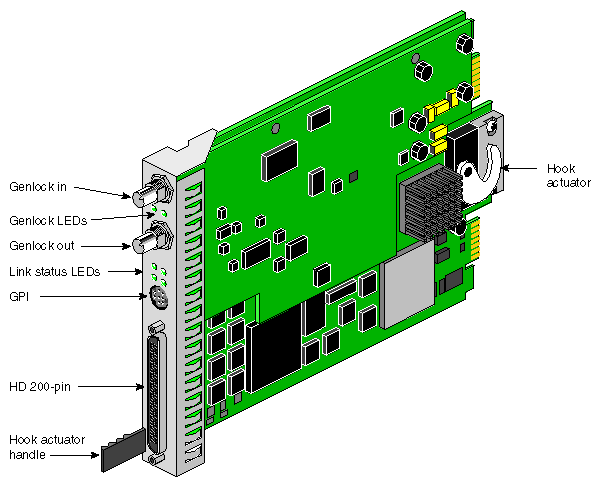
Figure 1-2 is a simplified top-level diagram of the HD I/O Board.
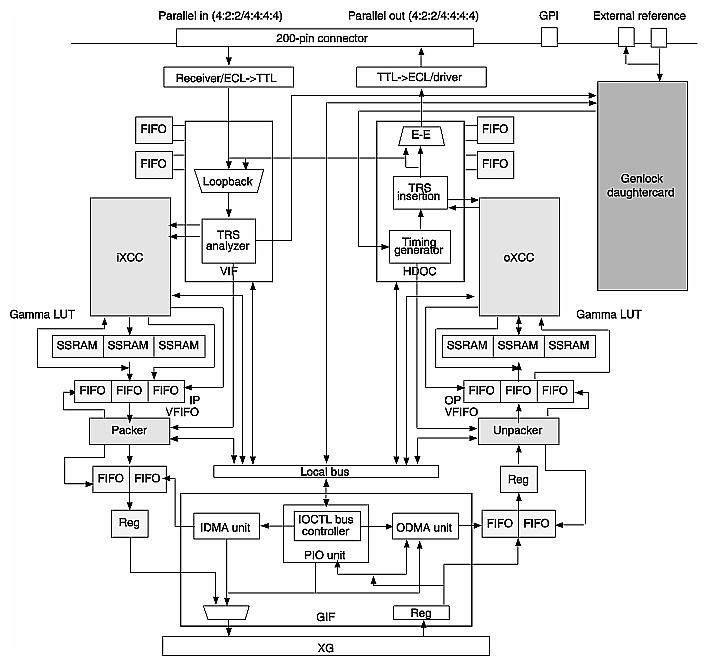
Figure 1-3 shows connectors on the HD I/O front panel.
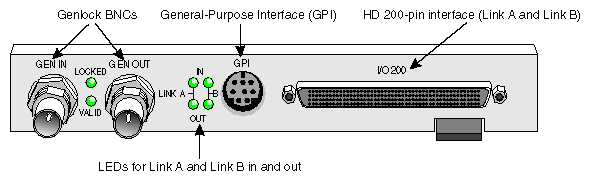
Figure 1-3 shows the two multiheaded cables included with the board; each has four 50-pin connectors for link A input, link B input, link A output, and link B output. The 50-pin connectors differ for each type of cable, following the Panasonic and Philips 50-pin video equipment interface standard.

Use the cable 50-pin connectors as indicated in Table 1-2.
Table 1-2. 50-Pin Cable Connectors
Label Color | Label: Panasonic Cable | Label: Philips Cable | Use |
|---|---|---|---|
Green | SGI <--- PANASONIC P1 | SGI <--- PHILIPS P1 | Input Link A |
Red | SGI <--- PANASONIC P2 | SGI <--- PHILIPS P2 | Input Link B |
Green | SGI ---> PANASONIC P3 | SGI ---> PHILIPS P3 | Output Link A |
Red | SGI ---> PANASONIC P4 | SGI ---> PHILIPS P4 | Output Link B |
For pinouts, see “Cable Connectors” in Appendix A in Appendix A, “HD I/O Board Specifications”.
You can use the four 50-pin connectors for 4:4:4:4 in d ual-link mode, or 4:2:2 in single-link mode where alpha is ignored:
In YCrCb 4:4:4:4 mode, Link A carries Y:Cr0:Cb0 (even Cr/Cb samples), and Link B carries A:Cr1:Cb1 (odd CrCb samples).
In 4:2:2 mode (single-link), Link A carries Y plus Cr and Cb; Link B is unused.
In RGBA 4:4:4:4 mode, Link A carries G:R0:B0 (even RB samples), and Link B carries A:R1:B1 (odd RB samples).
The selected video format determines Link A and Link B usage. For more information, refer to the following standards, which contain provisions for video signals:
-
SMPTE 240M corresponds to the early 1035i HDTV format. The HD I/O Board supports this model for compatibility with some equipment still using this standard. (This standard also defines color spaces, which must be set with a control, as explained in “VL_COLORSPACE ” in Chapter 2 in Chapter 2, “Programming the HD I/O Board”.)