The following sections provide technical specifications for the Silicon Graphics MultiLink and contain information about how the MultiLink complies with various regulatory agency rules.
This section lists various technical specifications for the Silicon Graphics MultiLink.
Table A-1 lists the power requirements and specifications of the MultiLink.
Table A-1. Power Specifications of the Silicon Graphics MultiLink
Specification | Value |
|---|---|
Input | 12VDC +- 10% |
Output | 12VDC +- 10% at 3.3 A maximum |
Power consumption | 6 Watts |
Figure A-1 describes the cables used to connect the video card in your computer with the MultiLink.
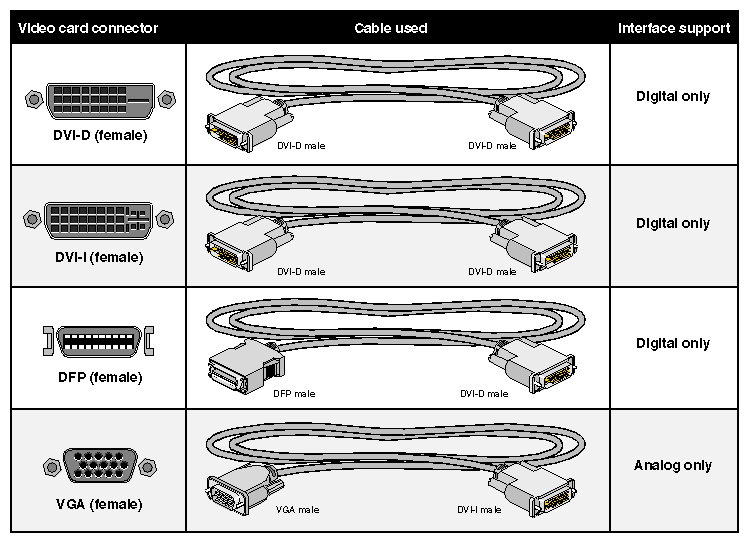
Table A-2 lists the MultiLink's physical and environmental specifications.
Table A-2. Physical and Environmental Specifications for the Silicon Graphics MultiLink
Specification | Value |
|---|---|
Size | 1.2 in. H x 8.7 in. W x 5.2 in D |
Weight | 1.5 lbs (.7 kg) |
Color | Gray/Blue |
Temperature |
|
Relative humidity |
|
Vibration |
|
Non-operating | .1 in., 5-12 Hz sinusoidal wave |
Shock Horizontal |
5g (49 m/s2), 15 ms half-sinusoidal wave |
Non-operating | 20g (196 m/s2), 10 ms half-sinusoidal wave |
Altitude |
|
The Silicon Graphics MultiLink accepts video signals using the resolutions and timings shown in the tables in this section.
The MultiLink supports only the video modes listed in Table A-3 through Table A-8. Other modes are not supported.
Table A-3. VESA Operating Modes
Resolution | Frequency | Total Horiz. x Vert. |
|---|---|---|
640 x 480 | 60 Hz | 800 x 525 |
800 x 600 | 60 Hz | 1056 x 628 |
1024 x 768 | 60 Hz | 1344 x 806 |
1280 x 960 | 60 Hz | 1800 x 1000 |
1280 x 1024 | 60 Hz | 1688 x 1066 |
Table A-4. Legacy DOS Operating Modes
Resolution | Frequency | Total Horiz. x Vert. |
|---|---|---|
640 x 350 | 70 Hz | 800 x 449 |
640 x 400 | 70 Hz | 800 x 449 |
720 x 350 | 70 Hz | 900 x 449 |
720 x 400 | 70 Hz | 900 x 449 |
Table A-5. Macintosh Specific Operating Mode
Resolution | Frequency | Total Horiz. x Vert. |
|---|---|---|
1024 x 768 | 60 Hz | 1312 x 813 |
Table A-6. 720P Operating Mode (SMPTE 296M)
Resolution | Frequency | Total Horiz. x Vert. |
|---|---|---|
1280 x 720 | 60 Hz | 1650 x 750 |
Resolution | Frequency | Total Horiz. x Vert. |
|---|---|---|
1600 x 1024 | 60 Hz | 1704 x 1056 |
Table A-8. Resolutions Affected by Overlapped Modes Menu Item[a]
Default Mode (Automatically Detected) | Alternate Mode |
|---|---|
640 x 400 @ 70 Hz | 640 x 350 @ 70Hz |
720 x 400 @ 70 Hz | 720 x 350 @ 70 Hz |
1024 x 768 @ 60 Hz (VESA) | 1024 x 768 @ 60 Hz (Macintosh) |
1280 x 1024 @ 60 Hz | 1600 x 1024 @ 60 Hz |
1600 x 1024 @ 60 Hz | 1280 x 1024 @ 60 Hz |
[a] Unlisted modes are not affected by the Overlapped Modes setting. | |
This product conforms to several national and international specifications and European Directives listed on the “ Manufacturer's Declaration of Conformity.” The CE insignia displayed on each device is an indication of conformity to the European requirements
 | Caution: This product has several governmental and third-party approvals, licenses, and permits. Do not modify this product in any way that is not expressly approved by SGI. If you do, you may lose these approvals and your governmental agency authority to operate this device. |
The Silicon Graphics MultiLink is FCC-compliant under test conditions that include the use of shielded cables. Shielded cables reduce the possibility of interference with radio, television, and other devices. If you use any cables that are not from SGI, make sure they are shielded.
Three cables that fit SGI specifications are shipped with each MultiLink.
The cable that attaches the MultiLink to your host computer or adapter board uses additional filtering molded into the cable jacket to reduce radio frequency interference. If your display cable becomes damaged, contact your service provider.
SGI designs and tests its products to be immune to the effects of electrostatic discharge (ESD). ESD is a source of electromagnetic interference and can cause problems ranging from data errors and lockups to permanent component damage.
The shielded cable that attaches the MultiLink to your host system or adapter board should be correctly installed and in good condition.
The following information is provided about the device covered in this manual in compliance with FCC regulations.
Trade Name | SGI |
Product | Silicon Graphics MultiLink |
Model Number | CMNB025B |
Date of Conformance | April, 2000 |
Responsible Party | Silicon Graphics, Inc. |
Address | 1600 Amphitheater parkway Mountain View, CA 94043 |
Telephone | 650-933-3405 |
This equipment complies with Part 15 of the FCC Rules. Operation is subject to the following two conditions: (1) This device may not cause harmful interference, and (2) this device must accept any interference received, including interference that may cause undesired operation.
This equipment has been tested and found to comply with the limits for a Class B digital device, pursuant to Part 15 of the FCC Rules. These limits are designed to provide reasonable protection against harmful interference in a residential installation. This equipment generates, uses and can radiate radio frequency energy and, if not installed and used in accordance with the instructions, may cause harmful interference to radio communications. However, there is no guarantee that interference will not occur in a particular installation. If this equipment does cause harmful interference to radio or television reception, which can be determined by turning the equipment off and on, the user is encouraged to try to correct the interference by one or more of the following measures:
Reorient or relocate the receiving antenna.
Increase the separation between the equipment and receiver.
Connect the equipment into an outlet on a circuit different from that to which the receiver is connected.
Consult the dealer or an experienced radio/TV technician for help.
This Class B digital apparatus meets all requirements of the Canadian Interference-Causing Equipment Regulations.
Cet appareil numérique német pas de perturbations radioélectriques dépassant les normes applicables aux appareils numériques de Classe A préscrites dans le Règlement sur les interferences radioélectriques établi par le Ministère des Communications du Canada.

